Showing posts with label Manzanares river. Show all posts

Friday, 1 July 2011

Madrid's River Manzanares. Where it begins....

Or Out of the frying pan and into the Fridge,
By Richard Morley.


When I wrote, a couple of posts ago, about Madrid’s new park running alongside the Manzanares River as it lazily glides though the city, I gave little thought to where that water came from. Like the crowds happily picnicking on the river banks in Goya’s famous painting above, I was quite happy to spend a cool evening beside the cool water.

Not many days later and Madrid stopped having cool evenings. The numbers on the electronic temperature displays at the bus stops climbed way up into the thirties and refuse to come down. Madrid is hot and sticky. The washing machine seems to be continuously on, removing the perspiration from several shirts a day, with the shower doing the same thing from my body. (I wish the guy on the Metro this morning had followed my example. It must have been yesterdays shirt. What a stink!)

Last week one of my students injured himself playing football and limped into Monday’s lesson wincing as he walked. On Tuesday he called and cancelled, claiming his ankle needed the expertise of a doctor. And so, with a free evening ahead, a friend suggested an escape to Madrid’s northerly mountains.

Now I like a walk in the hills, but I should have smelled a rat when she also suggested that I bring my swimming trunks.

By six that evening we had parked the car in an almost deserted car park in the Parque Regional de la Cuenca Alta del Manzanares, a nature reserve high in the Guadarrama mountains, recognised by UNESCO for its unique biological heritage and overlooked by La Pedriza, a huge granite uplift that dominates the region.

Geologically speaking, the Spanish word “Cuenca” means valley or bowl. Hence the town of Cuenca, which has nothing to do with this post, but where houses precariously hang from cliffs over-looking a deep valley. In the case of the Parque Regional de la Cuenca Alta del Manzanares, the “bowl” here signifies the confluence of several small streams into one main river valley which officially becomes the Manzanares river.

On the drive up to the parque I took in the scene of boulder strewn slopes and thought that at sometime in the past something pretty serious had happened to the geology. Granite is an igneous rock, spewed out by volcanoes, and here was several cubic kilometres of it. In places the granite was fissures and the cracks were filled with black basalt, again of volcanic production, and then it had been uplifted and split asunder. The area would have been pretty uninhabitable at the time. Now the parque is a peaceful retreat from the heat and bustle of the city. A place of shady pines and scented bushes, riverside walks and picnic spots. And, my friend told me, of places to bathe in the cooling water.


We left the car and strolled down the slope to the river. A handy sign informs you or where you are and what you can see. Beyond, a narrow wooden bridge, half submerged in the shadows of high tree – don’t ask me what they are, I am no botanist – led us across a narrow stream that tripped lightly over a few rocks and a fallen tree trunk.


A pretty little river I thought. But as we progressed up stream the rocks became boulders, the trickle turned into competing flows of white water. There was a water fall around every bend, and behind each fall a pool where people picnicked and splashed in the water.


Now, if you were to dip a toe into the waters of the Manzanares as it meanders though the city you might remark that the water is “refreshing”. But when the water reaches the city it is well on its way along its eighty-three kilometre journey from its source to where it joins the Jarama river. Yes, the “mighty Manzanares” is but the tributary of another. On the first half of its journey it has had time to relax under the warming sun while it dawdled in the Santillana reservoir, near the town of Manzanares de Real, and then slowly tumble along its lazy route, past courses for golf and horse racing, into the city.

 Cooling off in the cold, cold waters.

Up near its source, in the Parque Regional de la Cuenca Alta del Manzanares, the water is not “refreshing” but BLOODY FREEZING. A few degrees cooler and those sparkling water trickles would be icicles. It is not many days since the tumbling water of the Manzanares headwaters was snow peacefully at rest on the peaks of the Guadarrama mountains. Then summer arrived and raising the temperature by not very much sent the snowmelt in a raging torrent over the granite boulders where it splashed and tumbled, eddied and pooled as it squeezed through the rocks.

 A local resident basks in the evening sun.

Still unaware of just how cold this snowmelt was, as my friend and I walked along the river banks under a burning sun from a cloudless blue sky, I looked on with envy as groups of family and friends paddled and splashed in the water. The car park we had used was not the only one. My friend stopped a passing dog walker and asked him how far up river did the picnics and pool parties continue. He laughed sardonically, remarking that on a Tuesday evening he had hopes of having the woods and banks to himself, but that he thought most of Madrid, us included I suppose, had come out to spoil his evening.
 Going ...... going ........ soon to be gone. A boulder balances precariously over the river bank.

My friend remarked how nice it was to be able to walk unencumbered with a back-pack through the shady woods. I, being a gentleman, had volunteered to carry the back pack and grunted that I was happy for her. A language difference means that irony sometimes gets lost in translation!


The open and flattish woodland walk soon gave way to a more rugged and narrower path. There were cracks to be squeezed though, boulders requiring giant steps to surmount, sticky, snagging bushes to circumvent. All the while the laughter and joy of those who had already found their little pool of paradise rose up from the river.


Eventually we found an empty spot. A place of washed pink granite, known appropriately as Rose Granite, that had been eroded over millennia into broad, smooth beds which the acrobatic water washed with sporadic waves. We changed into our swimming stuff and dipped a toe in the water.


I shall not record the first word I used. Children might read this! Suffice it to say the coldness of the water came as a surprise. The second surprise was that the smoothness of the eroded rock allowed for no grip and I slid into the water. My friend was greatly amused by this, until the same thing happened to her and it took us a while to scramble back on to dry rock, which, compared to the water, was positively hot. Half on and half off the rocks we dangled our feet in the water. We had possibly walked four or five kilometres so the cold water gurgling though our toes was a welcome relief. Later, now with anticipation than ignorance, we let the water console more of our bodies.

 A couple of degrees less .....and this would be an icicle!!!

From the backpack she produced tortilla and bread and something to drink. Like others in their own personal paradises along the river bank we let all thoughts of hot and sweaty Madrid pass from our minds.

Walking back, with the sun casting long shadows and dappling the wood floor with light and shade, we noticed birds hovering on thermals over the Pedriza. The mountains here claim the title of the largest expanse of Granite in Europe.


On the way from Madrid I thought I was being clever and spotted the shape of a face in the rocks. My friend gave me that look which means I will for ever be a guiri and remarked that gazing at the slopes of the Pedriza is like observing shapes in the flames of a fire. She pointed out a tortoise, a helmet, which is what this particular peak, El Yelmo, is named for, and even a mammoth, while above us the rock formation known as the Canchos de los Muertos contemplated the living below.


I am told that there are nearly a thousand different routes for hill walkers and rock climbers within the thirty two square kilometres of the Pedriza. I had already had enough exercise for one day and the only exercise I was now contemplating was raising a glass or two of cold beer.


This was achieved after we drove out of the park into the small town of Manzanares el Real where stands a real medieval castle and a church tower swarming with storks.


Below that tower, in a small plaza, lay a bar. Around me kids, lots of kids, probably something to do with the storks, played in the plaza. A beer sat in front of me - but not for long!!

Now that was paradise.


Sunday, 12 June 2011

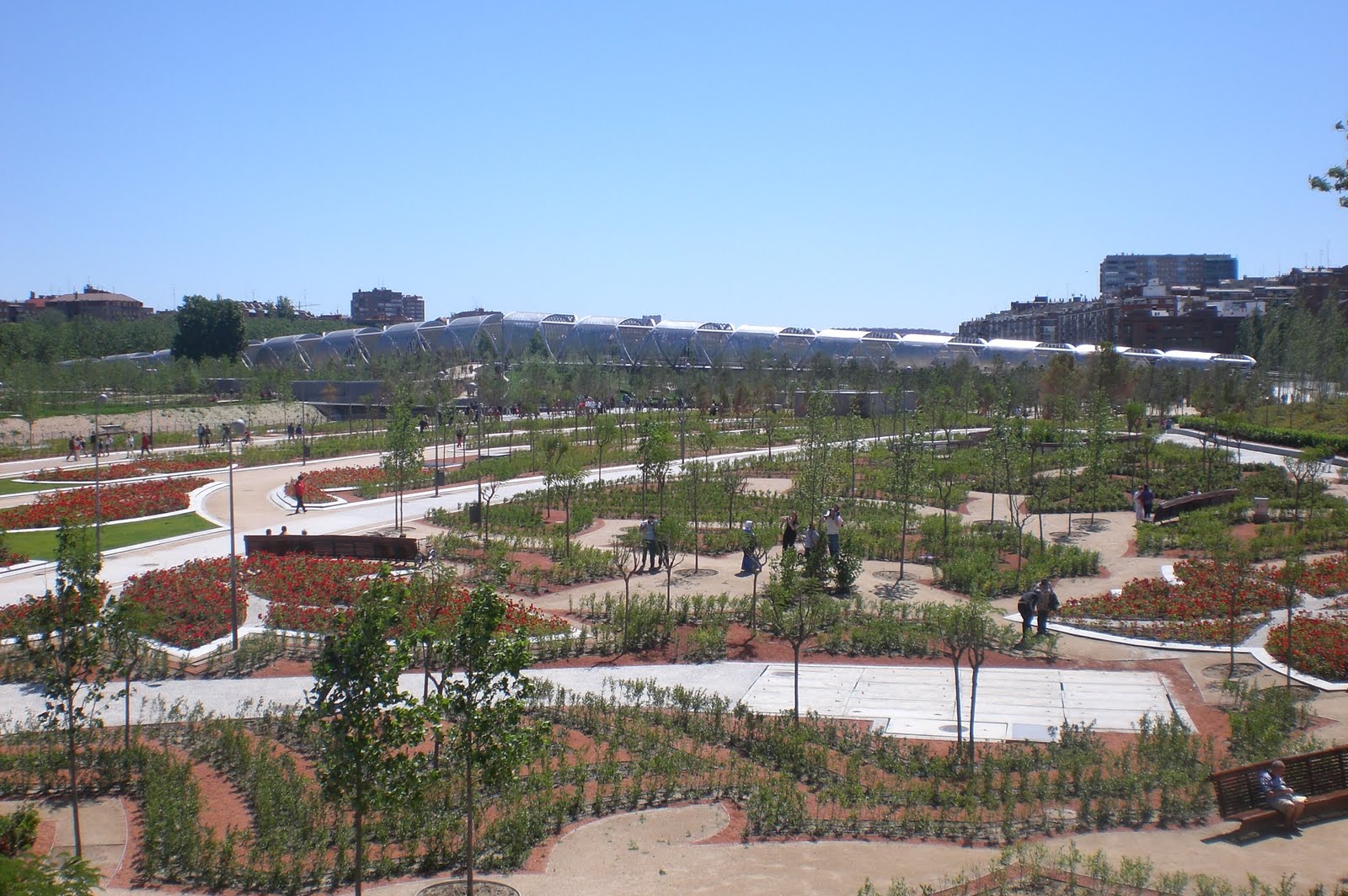
Madrid New Riverside Park - Madrid Rio.

By Richard Morley.


Six years ago when I first came to Madrid I  had no idea the city had a river. Today’s metro maps feature a zig-zag of pale blue giving an impression of the river’s route, but this doesn’t appear on maps until after 2007. The free street map given away by the tourist office also showed a blue squiggle in its bottom right corner with the word “Rio”, but no actual name. The delights of the Prado, the Plaza Mayor, Sol and Gran via are so far removed from the watercourse that the river hardly registered in the mind. While Paris and London were built on the flood plains of their great rivers early settlements in the Spanish capital tended to be on the high plateau, which was probably much better for defence than confined in the river valley.

While it might have supplied water for a small community, the Manzanares River has never carried enough water to provide for a thirsty city. I admit to having been rather scathing about the waterway in past posts, referring to it, ironically, as the “Mighty Manzanares” and quoting the wag of a couple of centuries ago who wrote that “The Manzanares is eminently navigable by a coach and horses”.

Could it be that the city was a little ashamed of its river?

Certainly the history of the river seems to be one of slight utilitarian use to the city and so little regarded as to be isolated between the north and south bound lanes of the M30 ring road. The river ran, hidden,  between them. In short, compared to the other delights of this wonderful town, the river was far from being regarded as one of  its attractions.

It was the forgotten river.

That has now changed! But it took a while.

In 2006 I made a friend who told me she lived close to the Puente de Pragua in an area of the city I had not visited before. So now I had a new part of Madrid to discover. My trusty Michelin Map told me to head on metro line 5 to Piramides and cross the river by the Puente de Toledo. What a terrible scene of devastation awaited me.

In 2004 a decision had been taken to redirect the M30 underground. Madrid’s alcalde, (mayor) Alberto Ruiz-Gallardón, or at least his advisors, had determined that the motorway was “a barrier to movement in the urban areas it ran through”. The old road was anyway in disrepair and it was thought that tens of thousands of vehicles polluted the air and the waters of the river.

I could have agreed with this. I live on the other side of the city where the M30, all eleven lanes of it, does not exactly contribute to a healthy atmosphere.

Diagram of a section of both tunnel and Park. Walking through the new park you have no idea of the traffic passing below your feet.

The project began in 2005, using one of the largest tunnel boring machines in the world, and was opened to traffic on the 5th of February 2007. I had arrived on the river bank at about the halfway point in its construction. It was a mess.

I took photos. See the “before” pictures in this sequence.


But now look at those I took a couple of weekends ago. The river banks have been transformed into a rather wonderful park known as “Madrid Rio”. It’s all very new and immature at the moment, but the trees will grow, the stone will develop lichen and the yellow cycle-paths stain.


This project has not been cheap. The tunnelising of this section of the motorway cost €237 million out of a total project budget of €3.9 billion. The actual cost of this new green area seems to be buried somewhere within those figures.


But whatever the cost, Madrid has a new park and the statistics are astounding.

23 new pedestrian bridges have been constructed.
3,200,000 square metres of new green areas have been developed.
26,263 new trees have been planted.
30 kilometres of cycle lanes and pedestrian paths
11 play spaces for kids
6 quiet spots for the elderly


Competitions were run in schools to find out what the kids wanted to have and it truly is a place for all the family. I am particularly impressed with the way the play areas, safely placed under the traffic overpasses have been used to provide shade and how the bridges themselves are used to secure the chains for incredibly high swings and some form of bouncy elasticised activity for which I have no name, but it involves strapping yourself to a bungee cord crucifix and bouncing around on a trampoline. It looks fun.

And very energetic!
 The Puerta de Toledo. Now cleaned and open to pedestrians.

Unfortunately I am no longer a kid. I prefer something a little more relaxing, and the new walkways through newly planted woods and flower gardens provide just that. A walk along the river bank with a friend would be the ideal way to spend an evening.

But the aforementioned friend had other ideas! (And not for the first time do I wonder why I seem to choose my friends from sadists!) “Madrid Rio is seven kilometres long. We should cycle. There’s a place we can rent bikes,” she announced, cruelly.

There is, and you can find it here.

 The Puente de Segovia with the Catherdral and Royal palace in the background.

It’s five minutes walk from the Puente de Segovia. It says on their website you could get there from either Príncipe Pio (Metro lines 6, 10 or R(from Opera) or Puerta del Angel (L6). Trust me when I tell you to only use Puerta del Angel, unless you want to walk what you will later be cycling.

 Not a sight you will ever see again. The author on a bike beside the Manzanares River. Note the upside down boat bridges in the background.

I calculated I hadn’t actually ridden a bicycle for fifteen years, but riding a bike is like, er, riding a bike. You don’t forget how it’s done, even if ones backside has become used to more comfortable seats.

It was a warm, sunny Saturday evening. My friend and I were not the only people to consider a camino along the river bank a good idea. This was disadvantageous to our bike ride. During my first visit, on foot, to Madrid Rio a couple of weeks previously I had thought that the bikers were a little inconsiderate in wanting to cut a swathe through the massed ranks of us walkers. Now the foot was on the other pedal. The walkers were getting in the way of us bikers. For this I blame the ayuntamiento. Whoever decided that allowing pedestrians and those on wheels to share the same space needs seriously to think again.
 The most modern of the new bridges accross the Manzanares. This is, officially, El Puente Arganzuela. It allows crossing between either side of the river in the new Parque Arganzuela. For strength it uses a helix design and so I think it should be known as el Puente del Sacacorchos, or "Corkscrew Bridge".

Spanish walkers spread themselves, as anyone who’s tried to walk along Gran Via will attest. Threading a strange bicycle while still a bit wobbly through years of no practise was precarious to say the least. I did not want a confrontation with a mother, or worse, an abuela, after little Juan or Jauna had been crushed under the wheels of my machine. What should have been done, of course, and has been done on the newly constructed cycle lanes in my part of the city, is to designate areas. A simple painted line is all it would take. Indeed, they have actually made this designation on one of the new bridges, but the pedestrians took no notice.


However, breaking news: Today it has been announced the Señor Ruiz-Gallardón, the aforementioned mayor, has decided that the solution to this is to restrict the speed of cyclists to six kilometres and hour. It will be interesting to see how this is enforced as the cycles we hired did not have any method of measuring out speed so arguments with uniformed park police pointing accusatory fingers could come to an impasse. Maybe we shall have to have a man with a red flag walk in front – or will that just add to the log jam?

But, pedestrian / bicycle gridlock aside, it was fun to ride these new lanes. The main problem is in the area now known as the parque de Aguanzuela, where most activity seems to take place. Once past that and it was almost the joys of the open road, cycling along side the river as far down as Legazpi / Usera.


Now the park is open the sluice gates have been raised and the river has an appearance of actually containing water. It’s not very deep water as exposed sandbanks attest, but it’s a far cry from the polluted days of before. Mother ducks led lines of chicks, a heron stalked the sandbanks and near the Puente del Rey a fisherman looked optimistic.

 While construction was going on the Ermita de Virgen del Puerta was buries in a sea of rubble. Now it is approchable though broad green parklands.

In a two fingered gesture to past criticism, most notably in a twenty year old pop song by the Refrescos which proclaimed the many attractions of Madrid but bewailed the fact it had no beach. “Vaya, vaya, No hay una playa en Madrid”, the song’s chorus proclaimed. This is no longer true. As part of the new park, Madrid has a beach – of sorts.

But some don’t need one. A stretch of grass will do. Crossing the Puente de Segovia one warm and sunny Monday afternoon I spied two bikinied young ladies working on an early tan. Encouragement indeed, if any were needed, to pay Madrid’s new attraction a visit.

Who needs a beach when a lawn will do. Bikinied ladies work on their tan bedside the river.