Monday, 3 January 2011

2010 revisited

By Richard Morley.

My camera is my notebook. When something interests, amuses or annoys me, then I ususally have my camera to capture it for all time. I am not a good photographer - more of a record taker. I have used many photographs on the blog during 2010, but some, either because they were surplus to requirements, or just didn't reall fit anywhere as part of a post, were put to one side. But waste not - want not. These pictures had a meaning for me at the time of taking them and serve to jog my ancient memory. Here are some of those memories from last year:

During one of my lessons an important point was raised for discussion: The correct way to pour a beer. Spaniards seem to like a lot of head, which us guiris view with dismay as we see the glass only half full. So, when stopping off at a café en route to Andalucia, I couldn't resist taking the picture below. Sometimes I feel like showing it to the many bar-tenders that don't follow the rules and serve me a glass of bubbles instead of beer.

There are parts of Madrid that are still a work in progress. Three times a week I teach in a built-up suburb to the east of the city, but that still has building space available. Left to themselves they have become tiny oases of grass and wild flowers. Each time I walked past this miniscule meadow I captured the growth. Below you can see it in late spring.


The same barrio, but a few blocks distant, and I came across one of my favourite subject - graffiti. It wasn't the artistic quality that made me laugh, but the way the "artist" extended the figure out on to the pavement.


It was difficult to avoid stepping on his toes!

The Spanish word for "cowboy" is vaquero. In the UK a cowboy is not a horse-backed cattle drover, but is a description of a tradesman who does a poor, cheap  job,  rarely finished on time, and then disappears, never to be found again. Not someone you would want to employ in your home, particularly with something as potentially dangerous as electricity. So I was tickled to see this sign on an electrician's van.


It is only the sign that amused me. I am sure he is an excellent electrician.

Another that I couldn't resist snapping, if only for the lack of logic in the "construction" of something "natural", was this:

Strange juxtapositions also caught my eye. Why, for instance, do our fire-fighters get their own exclusive ashtray?

All of us guiris are trying our best to learn the language. It's always a problem to know exactly the right thing to say when, for instance, eating out. So, a huge vote of thanks to the VIPs chain of restaurants for this useful list of phrases.


A dear friend called me one evening. "I've won some concert tickets in a raffle", she told me. "Would you like to come?" What sort of concert? I asked. "I don't know, but it's at the Auditorio Naciónal, so it's going to be classical". Well, I had always wanted to see inside this place, but the cost of tickets is prohibitive. (The tickets my friend had won had a face value of €134.13 iva incluido!) So I said I would love to. "When is the concert?" I asked and the reply was, "In an hour!" Luckily The Auditorio Naciónal is about five metro stops from where I live so, after a quick change of clothes, I made it in time. I met my friend and we checked the tickets, which gave no indication of what we were going to hear. This was solved when we entered and were given a couple of glossy programmes that informed us we were going to hear Bruckner's Third Symphony played by the Staatskapelle orchestra of Berlin conducted by Daniel Barenboim. Our seats were so close to the front I could have yanked on the tails of the great man's frock coat. Quite a good prize, I think. Before the concert began I took this picture of the inside of the auditorium and its massive organ. 


As spring turned into summer Madrid became the city we all love. The trees burst into leaf which cast shade from the sweat inducing sun. Even here, in the Paseo de la Castellana, it was possible to escape those searing rays.

Because, as this weather forecast on Sexta told us bluntly, summer was here to stay.


That picture was a direct photograph from my television screen. In April 2010 they turned off the old analogue signals and I was in danger of not having a TV as the set that came in my apartment was ancient with an indoor antenna, which would be useless with the new signals. I asked my landlady if she could arrange for me to be connected with the digital antenna on the apartment block roof so that I could then buy a special box  to convert the signals. A few days later, a hole was drilled into the wall and I had my connection. But the following day, her father knocked on my door saying, "We thought you would like this" and removed from its box a brand new digital TV. Sometimes I just cannot get over the generosity of the Spanish.

I took a few more pictures off the screen this year as there was no way I could get the advantageous viewpoint of the cameras of the TV stations. Look at this helicopter's view of the crowds in the Plaza del Sol on the night Spain won the soccer World Cup.


And from an even higher viewpoint:


The feeling in Madrid that night was electric. It was if everyone on town came to Sol to celebrate.

In the spring we had the festival of San Isidro, the patron saint of Madrid. It is an excuse for everyone to put on their finest clothes and walk about town.


Although some had to stay at home.


Slap bang in the centre of Madrid is a huge reservoir. Not that you would know as it is below ground and above is a modern sports centre with a golf driving range. But water does feature in the above ground part as I discovered walking between lessons one bright and sunny September morning.


Spain does not really have any dangerous wildlife: A few wild boars and the odd wolf and bear. But when walking in the country you have to be careful not to disturb a creature that will sting, bite and cause painful swelling. This is the processional caterpillar. In the countryside is one thing. I did not expect to find them out for a morning's saunter in my local park.


 No prizes for guessing why they are called "processional".

And finally - a load of balls. During the second weekend of September, for one night only, Madrid hosts hundreds of events cultural or silly. On the Saturday afternoon I wandered though the Plaza Dos de Mayo and found one of the silly, but fun, ones. My photograph shows only the early stages, but by nightfall the entire plaza was full of beach balls to wade though, play with, dive into. I went to a concert of the National Jazz Orchestra, but I am told by those who visited the plaza (where the best pizzas in Madrid can be eaten) a wonderful time was had by children and grown-ups alike.


Madrid can be silly or serious, highbrow or low, but never dull. Have I told you, I love it here!
.


Saturday, 1 January 2011

A Happy New Year - with cost constraints.

By Richard Morley.

Two years ago I celebrated the arrival of 2009 in Madrid’s Plaza del Sol. It was crowded, I was jostled, and I stood in one place for four hours. New year came, the bells of the clock on the casa de correos chimed twelve and we ate our grapes. There were fireworks, music and a laser show. It was great fun and a wonderful display of city pride, but it was now on my “Been there, seen it, done it – bought the tee-shirt” list and said I would never go again.

So what the heck was I doing there last night?

I have a friend who a few months ago moved to Spain for work. She is Scottish and therefore loves her New Year celebrations. Her Spanish friends and colleagues told her that most definitely she had to celebrate New Year in Sol. Enjoy the atmosphere, eat the grapes, drink, sing and be merry. It is a Great Spanish tradition.

And then all of her friends found something else to do!

So, instead of there being a crowd of us, it was just us two. We met early, planning to eat before joining the crowds in the centre. Her Scottish compatriot put it well when Robbie Burns wrote about “The best laid schemes o' Mice an' Men, Gang aft agley”, because where we had planned to eat had closed its doors for the night. Nearby was a VIPs restaurant, which informed is they were not cooking that evening. (So why the heck were they open?) They did however provide a pancake postre and a couple of beers, which saw us through.

My Scottish friend was amazed that catering establishments would so willingly give up the chance make money from the tens of thousands who attended last night’s celebrations. In Edinburgh, she told me, when the masses gathered in Princes Street to welcome in the new year, the restaurateurs and pub landlords would not waste such an opportunity to fill their cash registers.

Walking along the Calle Mayor last night we passed bar after bar whose doors were shut and in darkness. Even McDonalds was closed.

But there was drink aplenty in Sol – so long as you had brought it with you. Early arrivals came with a liquid picnic and sat on the cold slabs of the plaza. Some near us, had bought twin packs of Coke and Red wine taped together to create the instant calimochó and of course, there was Cava, the Spanish champagne, everywhere.

After our meagre dinner, my friend and I found our spot in the plaza and began the long wait for midnight. Our legs weakening, we followed the example of the picnickers and reclined on the cold, stone slabs of the plaza while we waited until the thickening throng started standing on us. One picnic group generously passed us a can of Cruzcampo to share.

The television companies, who had set up al fresco studios on the balconies and rooftops opposite the clock would incite the crowd to cheer and wave as they sought to add colour to their broadcasts. Those wearing garish wigs of bright colours out-numbered those who didn’t. I noticed a new line in headdress this year with the inclusion of Venetian masks, richly decorated, worn by the ladies. Men tended to stick to orange afros. A guy dressed as the pope staged a one man protest against the catholic church’s opposition to condom use, another group sailed a huge banner in support of the right of divorced fathers. An annoying guy banged a drum non-stop.

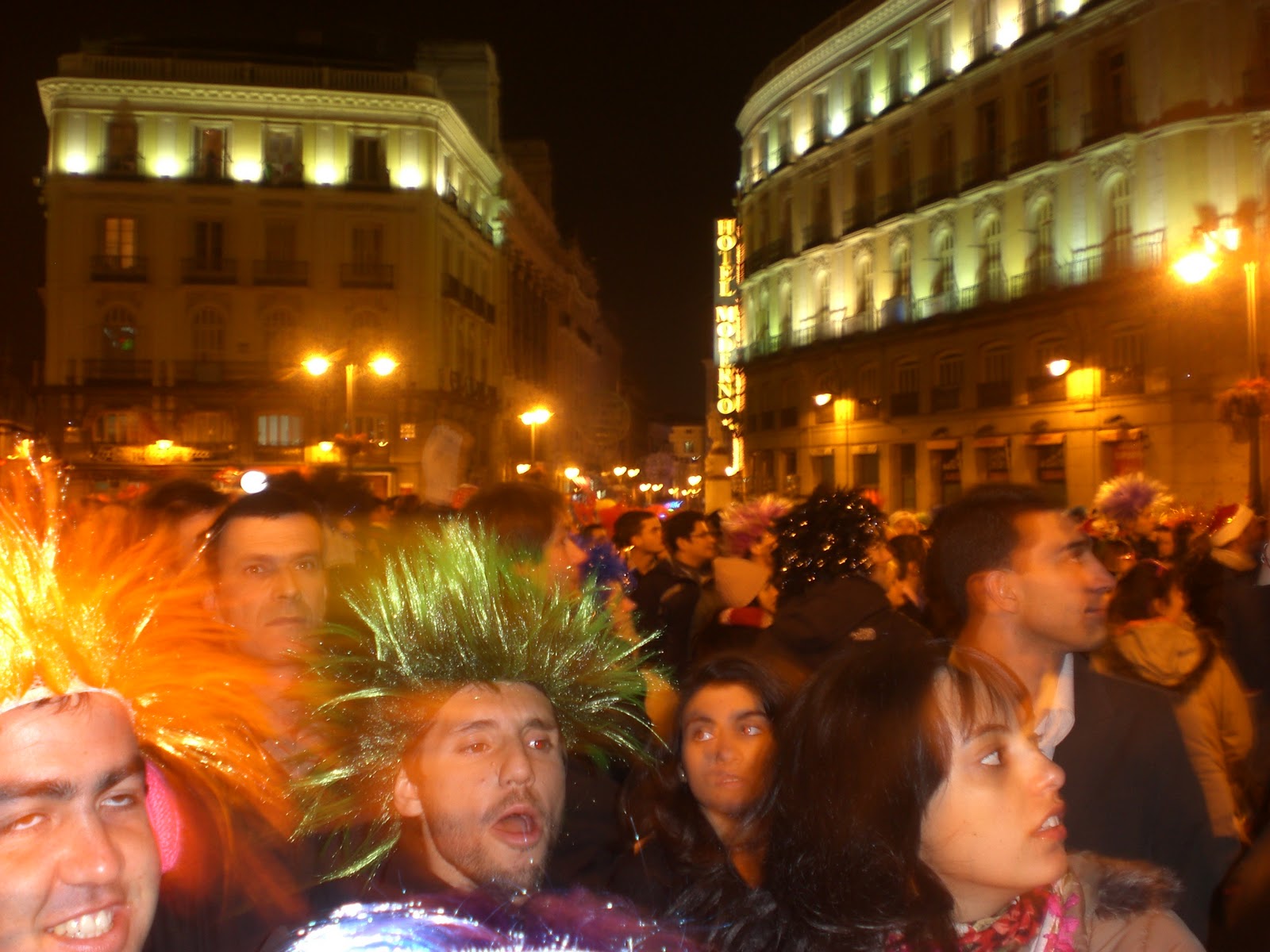
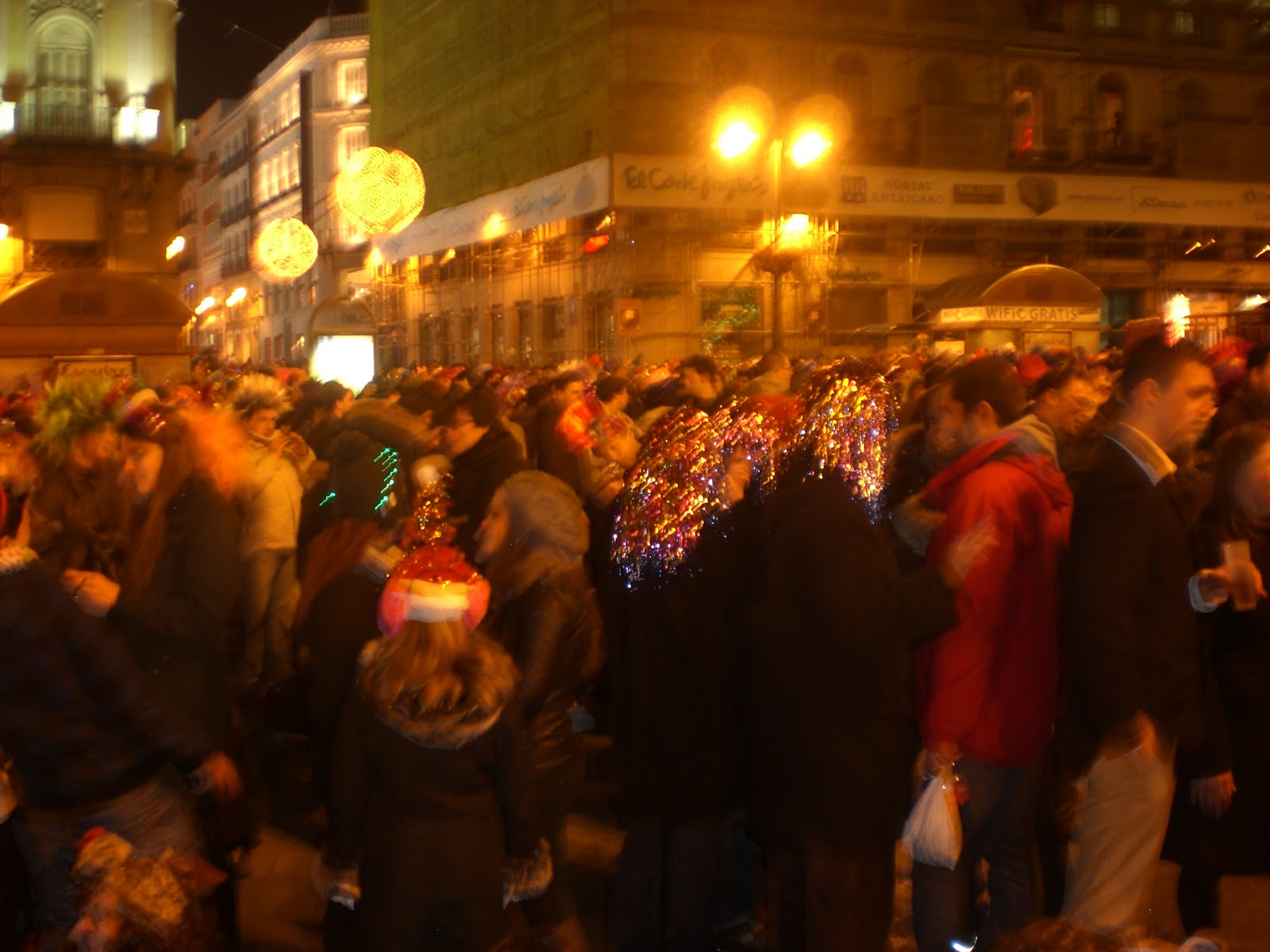
By eleven the crowd had grown to jostling proportion. We had to almost fight, at least be really stubborn, to maintain our position on the two stone slabs where we had staked our claim. But it was a good natured crowd with only a couple of *¨/&$Ys who rudely shouldered others out of their way without a perdone. There was singing, restricted dancing, and much taking of photographs. You can see my blurred offerings on this page. (I really must get a better camera!)


A minute before midnight and the already deafening screams of the crowd rose to painful. People prepared their little bags of twelve grapes, ready to consume one for each chime of midnight. It was a slow minute, but then the minute hand clunked up to vertical and the preliminary peal from the bells began, catching out those who thought this was the actual midnight chime. A few first grapes were consumed before the twelve strident bongs rang out across the plaza.

A grape for each chime. Manage this small feat will bring you luck for the year ahead. The noise fell to a murmur until the last grape was swallowed. Then the crowd broke into song, shaken cava fountained, unconsumed grapes were thrown. There were kisses and hugs, back slapping and wishes of Feliz Año on all sides. And then ……

Nothing!

No fireworks – no laser projections – no music. Around us people watched the sky expectantly. It remained dark. Someone in the crowd let off a small rocket and there were a couple of thunder flashes. But no official celebration. There was a definite feeling of anti-climax. Within minutes the crowd began drifting away. Some glancing back to see if something would happen. But no.

My friend and I joined the exodus and wondered off in the direction of Plaza Santa Anna in the hope of an open bar. No luck, they were all closed. What sort of celebration was this? Eventually we bought some beer from a Chinese shop and sat in a plaza near her hostal drinking and chatting. Passing strangers wished us “Feliz Año”, one man stopped and kissed my friend – and then insisted on kissing me!

A dead Plaza Santa Anna. No celebration here!

I would be lying if I told you I had not enjoyed the evening. I had a good time and in great company. The generosity and joy of the people around us was infectious. But there was something missing this year. It must be “La Crisis”. It would surely be wrong for the ayuntamiento to spend Money on public entertainment when so many are without jobs or have had their salaries reduced.

So I am curious to see to what extent the parade of the three kings will be reduced next week. Last years cabalgata was a fantastic show which must have cost a fortune to stage. It is a night of colour, noise and music. It’s the night when the three kings come to bring the presents for Spanish children. I hope they come in style.

After leaving my friend I attempted to get a taxi home; A necessity when, after attracting tens of thousands into the city centre for a midnight celebration they still insist on shutting down the metro at one-thirty! I had no luck and walked back though the town to catch a night bus from Cibeles. I did pass open bars, but with others closed those that were serving were packed beyond limit. It seems strange that in a time of financial uncertainty business owners would deliberately give up the chance of profiteering from the thirsty.

Spain, still, is different!

This blog is on the cusp of being two years old. Last month it achieved a record number of hits from every time zone around the world. For that, let me say a huge thank you to all of you for reading what I write and, sometimes, writing such encouraging comments in return. I apologise to those who were caught out by my annual Diá de los Inocentes mischief. We will continue to alternately roast or be soaked in the Plaza Mayor for a long time to come, and there will be no bio-dome in the Retiro.


And of course, allow me to wish all of you a very happy and prosperous New Year.


Tuesday, 28 December 2010

A Roof Over Your Head

By Richard Morley

It was bitterly cold. I didn’t want to remove my gloves to reach the cash in my pocket to pay for the caganer I had just bought for a friend’s Belen, the Spanish word for nativity scene. I love these little characters. They seem so irreverent during this Christmas time, yet they are funny. I was at the Christmas market in the Plaza Mayor. Darkness had fallen and the circles of illuminations swaying gently in the chill breeze above my head did nothing to relieve the cold.


The Caganeres often are used to poke fun at political figures or celebrities.

Summer visitors to Spain can hardly believe just how cold it can get in Madrid in winter. As I write this, the day after Christmas, it’s ten in the morning and there is still frost on the roof of the supermarket across from my apartment block. While I was out and about taking photographs of the Christmas lights for the previous post, the metal body of my camera was so cold I could barely hold it steady, and the ice-covered pavements first thing in the morning last week were a danger to life and limb.

When it comes to weather, Madrid, so centrally placed in the Iberian peninsular, is a city of extremes. So cold in winter and yet, so swelteringly hot in the summer months. I first arrived here one balmy May evening and fell in love with the city and assumed, so far south of a cool English spring, that this was normal in Madrid. My next visit, three months later in August soon dispelled that. The city was oven hot and sensible people took refuge in air-conditioned shops and museums.

And likewise, as soon as my business at the Christmas market was concluded, I escaped the bitter chill to a place of heated air and hot tapas. Albóndigas and Croquetas, steaming hot, was definitely something to be devoutly consumed.

It’s comforting to know that, at least as the plaza mayor is concerned, these extremes of temperature will soon be a thing of the past. Too cold in winter, too hot in summer, this jewel in the Madrid tourist crown will soon be a place of equitable climate all year round.

The Kagod Centre in Washington - designed by Foster and Associates.

Taking inspiration from more northerly countries, which have their own extremes of climate to deal with, the ayuntamiento of Madrid have decided to enclose the plaza under a roof of glass. The construction was put out to tender and the design of a Japanese firm of architects, Yono Creo and associates, has been chosen to do the work. Apparently they has stiff competition from an American company, Darel-Mentisa, who won the contract for the new bio-domes which will be erected at the south end of the Retiro park and which will incorporate the rose garden and provide a new home for the tropical garden currently housed at Atocha railway Station. The Retiro’s army of roller-bladers and skateboarders are said to be not happy at the prospect of losing their playground. The tropical garden at Atocha will become a business centre.

An example of how the southern half of the Retiro will look enclosed in the biodome.

This will not be the first time an open area has been covered with a glass roof. Just a block away in Sol the Casa de Correos, now the home of the Comunidad de Madrid, had its central courtyard covered long ago.

The Plaza Mayor however, covers a much larger area. The specifications for the new roof stipulated that there would be no central supports or pillars. One design proposed a light plastic roof supported by air pressure alone. This was considered unsuitable as it would have necessitated double-door vestibules at every entrance to the plaza to maintain the higher air pressure. The winning design was successful for two reasons. It incorporates a cantilever construction strong enough to support real glass. The glass chosen however, is far from ordinary. Reactive to sunlight like photo-chromatic sunglasses, the full glare – and therefore heat – of the midday sun will be mitigated. Every second pane will be a transparent solar panel generating electricity to power a climate management system, which will allow the plaza to maintain a comfortable environment at any time of year.

As someone who rarely goes to the Plaza Mayor, considering it a place for poor and expensive food, I think will make a great difference to this historic heart of the city. Just next door, the Mercado San Miguel has been converted from a run down food market into a sophisticated and up market food hall and the chosen meeting place of the Madrid elite. If the Plaza goes the same way it might begin to challenge the restaurants of La Latina, Chueca or Serrano.

A spokesperson for the ayuntamiento, Mentira de las Día de los Inocentes, has suggested that if the Plaza Mayor Project is a success, a similar roof will be provided for the bullring at Ventras, allowing corridas to continue all year round.

What do you think?
.


Sunday, 19 December 2010

Xmas in the City

By Richard Morley.
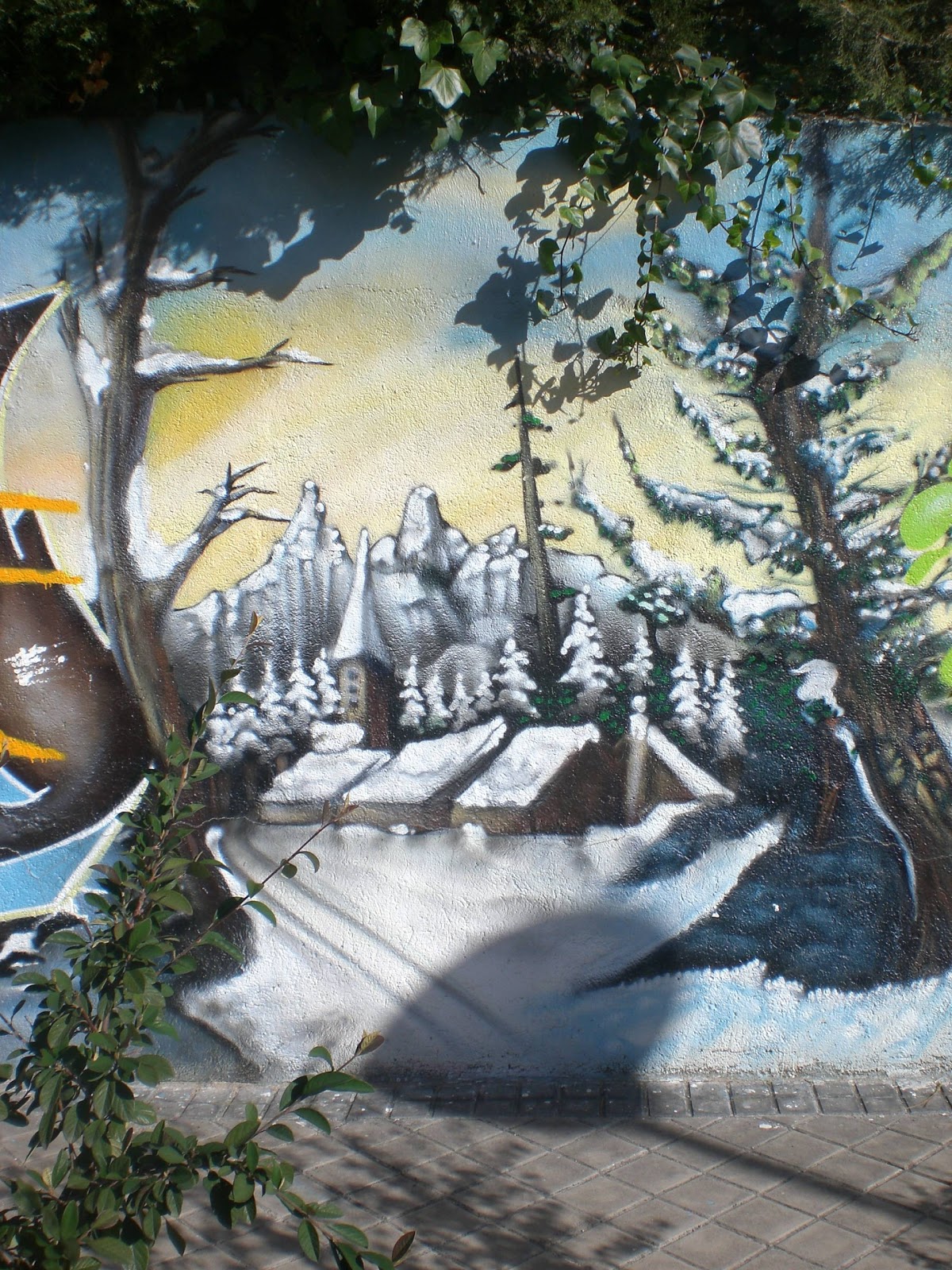
Madrid Graffiti. A winter scene painted on a wall near Arturio Soria.

Somewhere back in the archives of this blog, down in the comments section, someone once wrote a happily complimentary comment but finished with a suggestion that “You must certainly have a lot of free time on your hands”. I was cut to the quick. The couple of thousand words that he or she were commenting on had, as seems to customary for what I write, taken weeks of research, visits, photo taking and then the plain hard graft of actually sitting down and collecting my thoughts and research into a coherent whole.


This year, being the centenary of Madrid's (now slightly dowdy!) Centre Piece, the Gran Via, the sheer complexity of its history forced me into writing a trilogy. The finished result, liked by many, I am pleased to recount, reflected only the more striking, more interesting (from my point of view – this is my blog, after all) of all the stuff I had to sort through. Such is the complexity of the history of any great city. It was, in fact the culmination of seven months (on and off – this is not a full time occupation) of research on line, in my local library, asking people who had lived through that history and so on.

The history of the Madrid's water supply took almost as long. The Canal Isabel II, the name of the company that supplies Madrid with its water, is buried under a heap of its own self-congratulatory list of achievements. It will tell you how wonderful it is now, but how it began, using convict labour, poor geological surveys, and the usual Madrid political grumblings about its cost and who should take the credit, took ages to sift through. But I found the time. Nice comments made it all worthwhile.

Were that true now! As someone once said, “Time is like a handful of sand – the tighter you grasp it, the faster it runs through your fingers”. Can it really be that I haven't posted here for nearly a month? The trouble is that I have been plagued by that curse of life – work. Couple the offers of work with an inability to say “no” and suddenly “having time on my hands” is no longer an option.

So, apologies to those who have clicked on here expecting to find something new each week. But there are articles in the pipeline, so all is not lost.


However, here I am in that most majestic of cities, Madrid, at that most wonderful of times, Christmas, and Christmas in Madrid is always a huge pleasure. For a start, the roasted chestnut sellers are out in force. On your behalf I have been making my annual survey of many of the purveyors of this fine food. I have been disappointed in the Calle Goya, near to El Corte Inglés, where the dozen I bought were undercooked and three were bad, and astonished at the Puerto de Toledo where the lady there sold then in multiples of seven – so I was forced to buy fourteen. The choices were seven, fourteen, or thirty-five. Perhaps the latter is the “party pack”. But they were all good. Last year's winner, the man at the Plaza España was way up there in the rankings but a guy under the bridge at Nuevos Ministerios takes this year's award as the best chestnuts I have ever tasted. Perfectly roasted, he chose my solicited dozen with great care, segregating the nearly cooked from the over cooked until he filled the bag with twelve nuggets of sheer heaven. I was about to board the metro, which would have necessitated eating them in a rush, but I chose, after the first couple, to walk to the next station, savouring them as I walked.

I do despair for the poor street cleaners who have to follow in my discarded shell footsteps.


El Corte Inglés department store at Goya. The display is a sound and audio delight.

Due to “La Crisis” the illuminated decorations are, in many cases, the same as last year and there have not been nearly as many of those silly “Christmas Cones”, Madrid's mechanical solution to saving the fir-wood forests, as last year, although the monstrosity in Sol is there again. The thing about these metal surrogates is that they may look quite pretty all lit up at night, but their black ugliness during the hours of day light is no substitute for a real tree.
Golden Rings (ting-a-ling) along the Calle Naráez

And while the shops might be exhorting us to enter and buy, and with El Corte Inglés enticing us to “make a present of Christmas”, the shops have not been looking particularly Christmassy. There seems to be a dearth of Belens this year and although ECL have decorated the outsides of their stores, inside it is business as usual. The most successful shops seem to be those selling what I call “fire sale” goods. “Everything Ten Euros” proclaimed a shop in the Calle Alberto Aguillera this morning. I walk past these premises every week and each time it seems to be selling a different line of goods at knock down prices. Today, the last Saturday before Christmas, it was toys and games. Piled high and sold cheap. Inside was standing room only and a queue of expectant buyers stretched fifty metres along the pavement outside. A sign if the times.
Calle Goya all lit up.

At the other end of the financial scale, the finally finished Calle de Serrano, with its serried ranks of “posh” shops, seems to be doing an equally brisk trade. Serrano finally got rid of the workmen and machinery a few short weeks ago and, carpeted in pink, allowed its patrons to shop without fear of tripping over exposed pipe work or falling into deep trenches. In its first refurbished Christmas it has pulled out all the shopper attracting stops and illuminated itself like a fairy wonderland.

Serrano.

There is no doubt that “La Crisis” is biting into Christmas expenditure. One man, interviewed in the street on Madrid Direct, our local news channel, said that due to his unemployment “there would be no Christmas this year”, and I am sure that many will have to settle for less than before.


That said, the shops have been packed full of those who do have the disposable income to celebrate. Sol and its radiating streets have been jammed with package clutching shoppers since the start of December. I wonder what my friends have bought me!

If only they could buy me time.


Calle Principe de Vergara.

Sunday, 28 November 2010

The Things That People Do.

By Richard Morley.


I think it is time to book my room at the tanatorio across the road. The Tanatorio, for those of you who don’t know, is where they take the dead people en route to the grave. A grey, forbidding place, it is where relatives and friends to come and pay their last respects. When I eventually go there I want all my friends to come and shout at me, poke me, sing to me and make sure I am really dead before they do with me whatever they will. It’s just a precaution.

My local Tanatorio is about three hundred metres away from my apartment as the spirit flies and as I often walk past it I can say that I have already made my final journey many times.

But why do I have these thoughts about my own mortality? Something terrible happened today. A young man, sporting a New York Yankees jacket, Silver and blue Nike Trainers and an expert juggler’s set of rings in his left earlobe, offered me his seat on the bus.

Ok, my hair is grey and the skin around the eyes is showing signs of age, but inside I haven’t aged a bit since my twenty-first birthday, but by outward appearances obviously this young man thought I am getting on a bit.

As the bus emptied and filled as we went from stop to stop the young man would find a seat, but immediately offer it to some ancient who shuffled on board at the next stop. A well brought up, polite young man, who seemed to have a mission in life as a seat warmer for wrinklies.

I was on my way to give a lesson in Castellana. I was early and so found an empty banco, or bench, to while away the minutes with a cigarette and a quick review of the lesson of prepositions I was about to give. A few metres away stood a water fountain, a thing of cold, dull, cast iron with a sprung-loaded tap. A very dishevelled – unshaved, raggedly dressed – middle-aged man approached the fountain and removing a reclaimed yoghurt pot from his stained pocket, proceeded to rinse it out; throwing the water in all directions. He then took a drink and, thirst assuaged, stumbled a few metres to a tree and urinated, totally oblivious to my presence and that of passing office girls on their way to lunch.

I have a feeling that British office girls would have reacted with cat-calls and loud comments. Their Spanish counterparts walked past as if nothing unusual was happening.

A couple of hundred metres north, where Castellana intersects with Ayala an old man, his head swathed in a threadbare woollen scarf, a grubby raincoat flapping about his knees and a crutch, waited for the traffic to halt for a red light. He would then stumble his way through the stopped cars, leaning heavily on the crutch, while banging on windows and thrusting a plastic cup in the faces of drivers, begging for money. He would, perhaps, approach seven or eight cars before the lights began to change. As the engines started to roar he would make his way to the kerb and walk, quite unaided by the crutch, back up to the lights and await his next queue of victims.

The things people do sometimes astounds me. And travelling around Madrid from lesson to lesson, I see a lot of people.

Sometimes I am pleasantly surprised. Like the time a gang of leather-jacketed, chain jangling youths swaggered towards me taking up every centimetre of the width of the pavement as if they owned it. But just before they reached me, two of them stepped down into the gutter allowing me to pass while begging my “perdón, señor”. My landlady’s teenage son, who shouts and slams doors while at home, approached me in the local supermarket recently and insisted on shaking my hand before politely asking for a loan of my house keys.

Sometimes I am surprised by rudeness, like the old ladies who consider, unlike the youths above, that the pavement does belong to them and that four women walking abreast should not give way to oncoming pedestrians. And don’t get me started on their use of umbrellas or shopping trolleys.

And sometimes I am just perplexed. I watched a young woman the other Saturday morning try four different seats in an uncrowded bus until she was happy. I was reminded of the way that dogs go round and round in circles until finally flopping onto their beds to sleep, or will sniff every bush or tree before finding just the one to relieve themselves against.

Others board the bus and take an aisle seat, leaving the inner seat, next to the window, empty. At the next parada a new passenger gets on and despite there being a plethora of other empty spaces, insist on taking that free window seat. This sets me wondering on two levels: One, why did the first passenger not slide across to avoid the business of getting up, standing aside, and retaking his or her (and usually it’s a her) original seat? And two, why did the second passenger not just take one of the available empty seats?

And while I am on the subject of taking the bus. Why can’t those with abonos find their ticket before the bus arrives, instead of climbing on board and only then, with a queue behind them, begin to search pockets and handbags for that elusive red plastic wallet? ¡Qué fastidio!

Or those who hesitate before stepping on to a metro escalator, as if waiting for just the right step to come along before they will use it. As my Facebook friend Sophia once asked, “What are they waiting for? A shiny one?”

But worse are those who reach the top of the escalator, step off, and then stop, dead, while those coming up behind them have to swerve or leap around them. What are they doing? Planting a flag and claiming the lobby for Spain?

But it’s while they are riding the metro that you will witness the unexplainable. There seems to be an unwritten rules that the end seats of a row of four will not be left unattended. Imagine, four people sit in a row. The train arrives at a station and those occupying the end seats get up to leave. Immediately those in the centre seats will slide over to take the freshly vacated, still bottom-warm, seats of the just departed.

Ok, I’ll admit I have done it myself if, say, a couple get on and want to sit together. So I will ask the question of one of life’s little mysteries: Why do ladies leave warmer seats than gentlemen?

Then moving upwards to the surface and Madrid’s busy, traffic tangled streets, I might ask the purpose of traffic lights as at junctions not under surveillance by CCTV. No one seems to obey them at all. Red or amber lights seem to have the sole purpose of telling the drivers there might be crossing pedestrians to weave around. They don’t seem to be there to inform the driver he has to stop and let people on legs cross the road safely.

A few months ago I was actually hit by a car as, with the permission of the little green men, or flashing viejos verdes, I was crossing a road when this car swung round the corner and came straight at me. The driver slammed on his brakes and did manage to stop just as his front bumper came into contact with my leg. No harm done, no bruises, not even a scuff mark, but I left the driver in no doubt what I thought of his ability and, to give him his due, he signalled his apology with that praying hand sign they seem to know, and probably practise, so well.

My friends told me I could have sued. That I should have acted terribly hurt, leaping up and down while holding a supposedly injured limb, while promising the driver that if he slipped me a hundred euros I wouldn’t call the police. Hey ho! Another lost opportunity.

This has happened just once, but almost happened a hundred times. It might not be old age that books me that one way trip to the Tanatorio!

But why do drivers ignore the lights? And come to that, why do pedestrians? They step out on to the road at the first twinkle of changing colours with no thought to the tons of metal hurtling towards them as their drivers attempt to cross before the lamp turns irredeemably red. Perhaps they have a suicide wish. In fact I am sure of it. I know one lady who will grab my arm and say, “Quick, let’s suicidarse” at the slimmest break in the traffic. Another, given the choice of two crossings a hundred metres apart on the busy Calle Conde de Penlaver, thought the best place to cross was almost exactly halfway between them.

And sometimes the things that people do are just amazing. The generosity of the Madrileños is not confined to being quickest on the draw when it comes to picking up the tab. Ask directions and chances are you will be taken there, or at least to the right intersection and have a landmark pointed out to you. Admittedly their willingness to engage in conversation can be a little annoying when you are in a hurry, but you can’t fault them for friendliness. Then again, I have had many a Spanish lesson from waiters and waitresses in cafés and restaurants. I still remember the waiter in the Plaza mayor, in my early naïve days here when I thought that was a good place to eat, who taught me “postre”.

For that matter, I am amazed at the patience they show while attempting to improve my abysmally bad Spanish, sitting for hours speaking s-l-o-w-l-y and carefully so I can understand and putting up with the ungrammatical nonsense they get in return. And that includes the assistant in the pharmacy who wouldn’t let me pay for the painkillers I needed for a bad back until I proved I could pronounce “Ibu-pro-feno”. She made me repeat it three times before relinquishing her hold on the packet.

As I write this, although I won’t publish for a couple of days, it is Thanks-giving day in the United States. In the five and a half years I have lived in Madrid I keep finding more and more things that I should be thankful for.

My sister once asked me how I could live in a country where I felt like a “foreigner”? The answer to that is that I don’t. And for that, to all the people who reside in this fantastic city, with all their strange – and suicidal – ways, I want to say thank you.

And I should say it now, before I die. A thousand curses on that polite, well-bred young man. Why couldn’t he have just let me stand. The Tanatorio is not far, and should this be my Last Post, remember this, in that place, one room will be forever England.

Tuesday, 9 November 2010

Life in the Colonies

By Richard Morley.

At eleven o’clock, one Monday morning, I boarded a number seventy-seven bus that took me all the way to the End of the Week. And when I got off, I found myself in December.

No, I wasn’t smoking something illicit. I had been searching for a bus route that would take me to one of Madrid’s large out-of-town shopping centres and noticed on the itinerary displayed on the EMT’s (Empresa Municipal de Transportes de Madrid ) website, that the final destination of this particular route was a place called the “Colonia Fin de Semana”, and the more detailed listing of the paradas de autobús named the final stop as the Calle de Diciembre.

The stop I was searching for, the nearest to the shopping mall, is actually half a kilometre away from the centre and why the public transport companies, EMT or Metro cannot provide a service that would actually take the shopper directly to a popular shopping centre is something I just can’t understand.. (The nearest Metro station is half an hour’s walk away on the opposite side of a busy motorway crossed by a high footbridge.) I was checking prices for a heavy printer I have my eye set on, but the sheer distance I would have to carry the thing to the bus stop has decided me against buying it from there. This failure to provide a good transport link to this part of Madrid is a rant for the future, but why was my eye drawn to the last stop of the route?

Scattered around Madrid’s neighbourhoods of high rise dwellings are some curious links to the past. I can look down on one from my fifth floor apartment window; A collection of some thirty, small, two storey houses set on about a hectare (roughly two acres for my non-metricised readers) served by two narrow streets. Each house has a high wall to protect the inhabitants from the eyes of the curious. Over every wall can be seen the straggling stems and branches of mature gardens. Peering through gaps one can see private patios and personalised entrances.


Surrounded on all sides by eight, ten and twelve storied apartment blocks these compact houses seem very much out of place. But in fact, it is the high rises that are the usurpers. This small colony of houses was here long before the developers began building in the mid fifties. And it has a name; La Colonia de los Carteros. Yes! The Colony of the Postmen (or mailmen – again for my US readers.)

These “Colonias” are dotted all over the city. As in the case of my neighbours, some were built to provide housing for workers in one sector or another. They are not all pretty little houses. Some are more utilitarian like the Colonia San Cristabal, occupying a few streets opposite the Cuatro Torres, and was designed to provide housing for employees of the bus company. Some were built just to provide affordable housing for anyone.


The Colonia de San Cristabal. Built in the first half of the 20th century, they are now dwawfed by the monsters of the 21st.

The key word here is “affordable”. Actually that’s not quite right. In December 1921 and July 1922 two pieces of legislation were passed known as “El ley del Casas Baratas”, or the Cheap Housing Law. These laid down in Spanish law some principles that were sweeping Europe at the time, which were to provide housing for workers that had to be of good quality, sanitary and low cost. The bywords were “Simple construction with economic materials”. In the late 1800s the United Kingdom has legislated the “Labouring Houses Act” and France saw the creation of la Societé française des habitations à bon marchè.

In Spain these laws specified minimum build quality, cost, and, and this really drove the movement, gave subsidies and tax breaks to companies who provided such housing.


The narrow streets of the Colonia de los Carteros

Given that low cost was the major factor, it is not surprising that these “Colonias” were built outside of the city on previously unused land. My neighbours in the Colonia de los Carteros, built in 1922, are nearly five kilometres from Madrid city centre. I have been told that prior to the 1950s my part of Madrid consisted of open fields with only scattered housing. It’s different now! The Colonia de Retiro, which was built on new land off the South East corner of the famous park is just three kilometres from Sol, yet at the time of its construction was completely isolated from the city and is now completely surrounded.


The Colonia de Retiro: Quite isolated when it was built (top), now, as shown in this Google Earth image (bottom), totally absorbed into the city.
 
Seven kilometres south west of Sol you will find the old Colonia Militar Arroyo Meaques. Lying within sight of Colonia Jardin metro station on line 10, it fiercely maintains its independence from the encroaching high rise apartments.

Colonia Arroyo Meaques seen across the carpark of the nearby Colonia Jardin metro station
Rows of pretty cottages in Arroyo Meaques

A stroll around the Colonia quickly shows that this was almost a self contained village. At one time the colony had its shops, its bar and it church. The old town hall reveals its village like status before the approaching Medusa like tendrils of the city. The cottages have been maintained or restored the way they were built and it really is like going back in time.
It would almost be a village scene if it wasn't for the high rise beyond

A fig tree escapes its confines. Away from the city's bustle, perhaps just two hundred metres away, it's like being out in the country.

There is a reason behind this. The reason why these tiny enclaves continue to exist and have not been demolished in the path of profitable high rise apartment blocks is because they are protected by law. In 1997 an act was enabled that enforced on them a “listed” status, as it is called in the UK. The insides may be modernised but their exteriors must be preserved. There are by-laws which protect and extend beyond the properties to the streets outside with restrictions on parking, and what you can and cannot do.

When you consider what the value of the land would be to a developer, these very houses that were built as “casas baratas”, have now become very valuable indeed.

What this has done, of course, is to create enclaves of small, expensive housing. If you were lucky enough to inherit, you would be sitting on a gold mine. Otherwise, if you want to live here, and I think I could very easily, then you will have to wait for that lottery win.

But the people who live in the Colonia Militar Arroyo Meaques are not so rich. A couple of blocks away is a disused army base and the houses are owned by the ministry of defence. The residents are ex military personnel who, amazingly, rent their homes for the grand sum of two hundred Euros a month. Originally built to house officers the houses are quite large. In recent years the colony has been refurbished at a cost of three and a half million euros. The pavements are neatly block-paved, the roads freshly asphalted and many of the one hundred and thirty three houses have been completely renovated, while still maintaining the old external appearance. There are a few houses still in the process of renovation and signs affixed to the walls of empty properties proclaim them to be “Almacén del Invifas”, which means they are the property of the “Instituto para la Vivienda de las Fuerzas Armadas”, or army property, and is a legal necessity to stop squatters.

A cottage in the (very) early stages of renovation
The cost of renovation, incidentally, was shared by the Ayuntamientos of Madrid and Pozuelo as the colonia lies on the boundary of the two, leading to the somewhat ridiculous matter of there being two different designs of lampposts in the streets. The military, whose personnel benefit from the renovation, paid nothing.

However, as well as providing living accommodation for workers, some of these colonias were nothing more than holiday homes. In the same way that well-off Madrileños today have second homes on the coast or in the cool hills north of the city, the pre-motorcar age required these week-end “get-aways” to be closer to home.

That very philosophy is, obviously, reflected in the name of the place where I began this article: La Colonia Fin de Semana.

Situated some twelve kilometres east of Madrid and a good couple of kilometres beyond the advancing tide of high rise apartments, this “Colonia” still betrays its origins as a “get away” place. It’s central plaza is wide and gardened.

The cetral plaza in Fin deSemana
There are open spaces used for growing vegetables and old houses with sprawling vines and crawling roses. But its artificiality is apparent. The streets are laid out on a strictly regimented grid and named, (by lazy, unimaginative planners) in order, after the months of the year. Hence my untimely arrival in “Diciembre”. Unlike the bucolic joys of the Colonia Arroyo Meaques, which strives to maintain a timeless quality, the Colonia Fin de la Semana is undergoing development.

Ancient dwellings resist the encroachment of new development.

Regimented rows of modern houses, obviously for the well to do, stand cheek by jowl with the ancient cottages. Untended wildernesses wait for the developer’s bulldozer. Much of the northern half of the Colonia is industrial, with builder’s yards and ironworks. Not as pretty as I thought a weekend retreat should be.

I suspect I was not the only one to be disappointed. Within minutes of arriving I was approached by a back-packing Australian couple who, with not even a faltering attempt at Spanish, asked me for directions. Am I so obviously a guiri? Well no, because their surprise was palpable when I replied in English, “Sorry, I haven’t a clue”, when they were expecting a Spanish reply. I would never, in any non English speaking country, approach a stranger without some attempt at the local language. I wonder why this couple, well, the woman, thought it was ok. However. I don’t think the Colonia was the tourist sight they expected to see.

Fin de Semana now provides housing for all of the week.

 
A close scrutiny at any map of Madrid will reveal many of these “Colonias”. There are, in fact, forty two designated, and protected, as “colonias históricas madrilènes”. Some don’t actually have “colonia” in the name, but they are there. And you don’t have to go far to find them. The top end of the Calle Serrano will put you right in the centre of where Madrileñillos used to spend their weekends. There are four just behind the Real Madrid stadium; El Visto, Cruz del Rayo, (built to house civil servants), La Prensa y Bellas Artes (to house writers, journalists and artists – obviously) and Iturbe IV for professionals.

The Chamartin district boasts seventeen. Prosperidad, a lovely name, for one, was built under the 1927 law of cheap housing for labourers. The list also includes Socialista, Jardin de Rosa, Los Pinares, Las Magnolias, Los Rosales and so on. While Iturbe III was constructed by the Cooperativa Madrileña de Casas Baratas y Económicas slap bang in the middle of the Salamanca district for who knows who, but just think of the prices these properties in that area fetch now!

I can sort of tell you, although the documentation I have found is about six years old. In Salamanca the prices for the houses in the three colonies of Carteros, Iturbe III and Fuente del Berro were around €4,800 per square metre. So, half a million each, which actually isn’t bad for that area, but the places are tiny.


Some of the properties protected by the 1997 law are not parts of colonies, but individual holdings. For this reason you will find many ancient, slightly rickety, little houses completely swamped in a sea of high rise blocks.


Some are quite charming, if not seeming a little lonely. However, a quick glimpse thought a chink in a wall, or through a half open gate, reveals well cared for properties and a view of how Madrid used to be before apartment living was the norm. Long may they last.

Below - Experience a year in a Weekend